You may think that managing complex IT has to be hard — buried under frameworks like IT Service Management, ITIL, ISO standards, and audits.
But what if we’re living in a different era — what if we stopped managing complexity — and instead let systems understand themselves?
Focus on sales. Earn money. Enjoy it. Let ADRAGON handle the operational reality of your IT.
ADRAGON is an IT Service Management add-on built on the EnterAI platform.
It introduces a new generation of AI-driven processes that dramatically reduce IT operations costs, expose operational risk in real time, and deliver measurable return on investment.
Build a living CMDB from continuously updated, contract-true data — ready for operations, finance, audits, and customer trust.
Your contracts already describe your IT landscape. They are just written for humans, not for systems. At ADRAGON team, we believe a CMDB only makes sense when it is grounded in contracts and agreements — turning analytics from assumptions into facts.
ADRAGON AI reads contracts from whatever source like OneDrive, SharePoint, or Google Drive and automatically turns them into structured configuration data like:
Service
What is delivered
Vendor
Who provides it
Client
Who receives it
Sub-contractors
Dependencies made visible
Duration
Start, end, renewals
Contract items
Systems and services (e.g. SAP)
Description
Scope in structured form
Conditions
Service level agreements
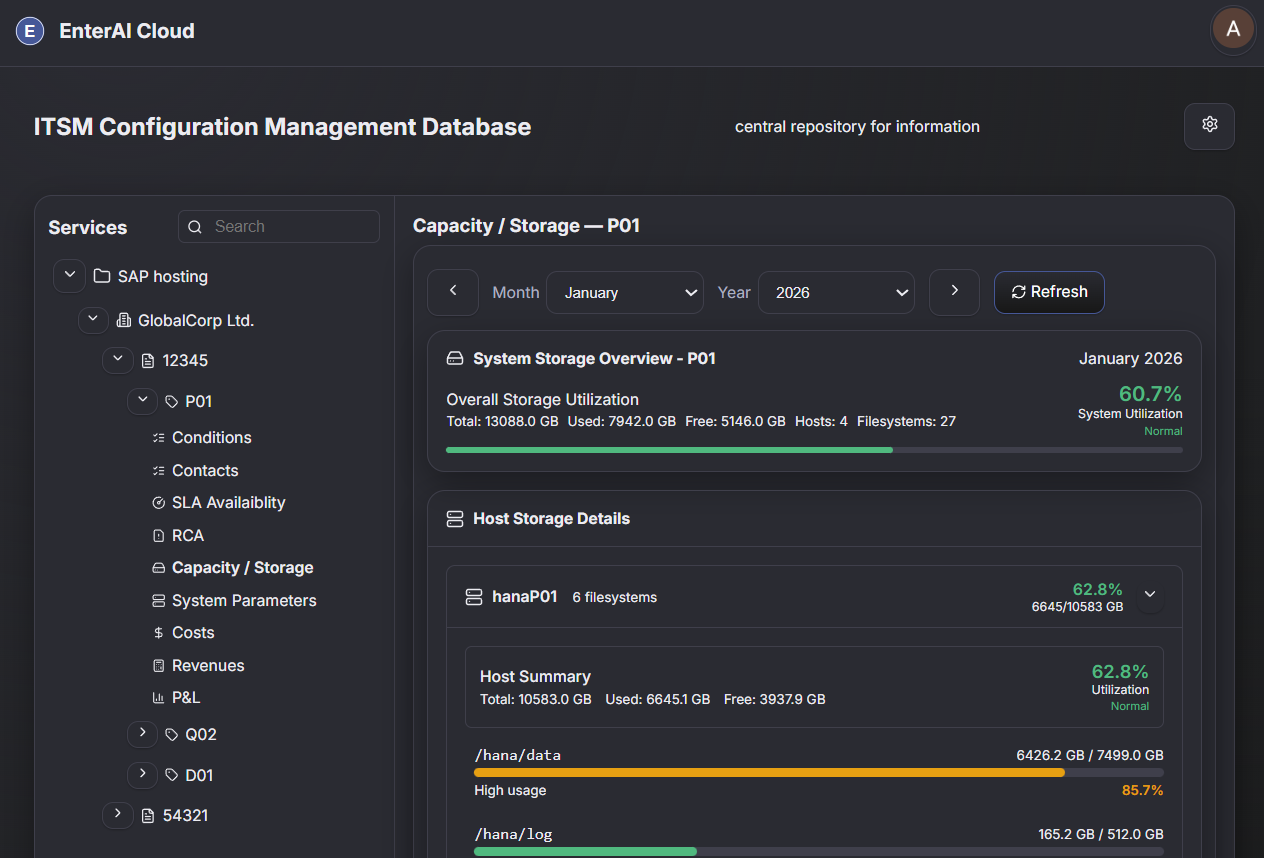
Your vendors already provide detailed service reports — from cloud providers like AWS and Azure to infrastructure and application partners. These reports are always up to date, reflect the real state of your IT environment, and often include critical financial and consumption data.
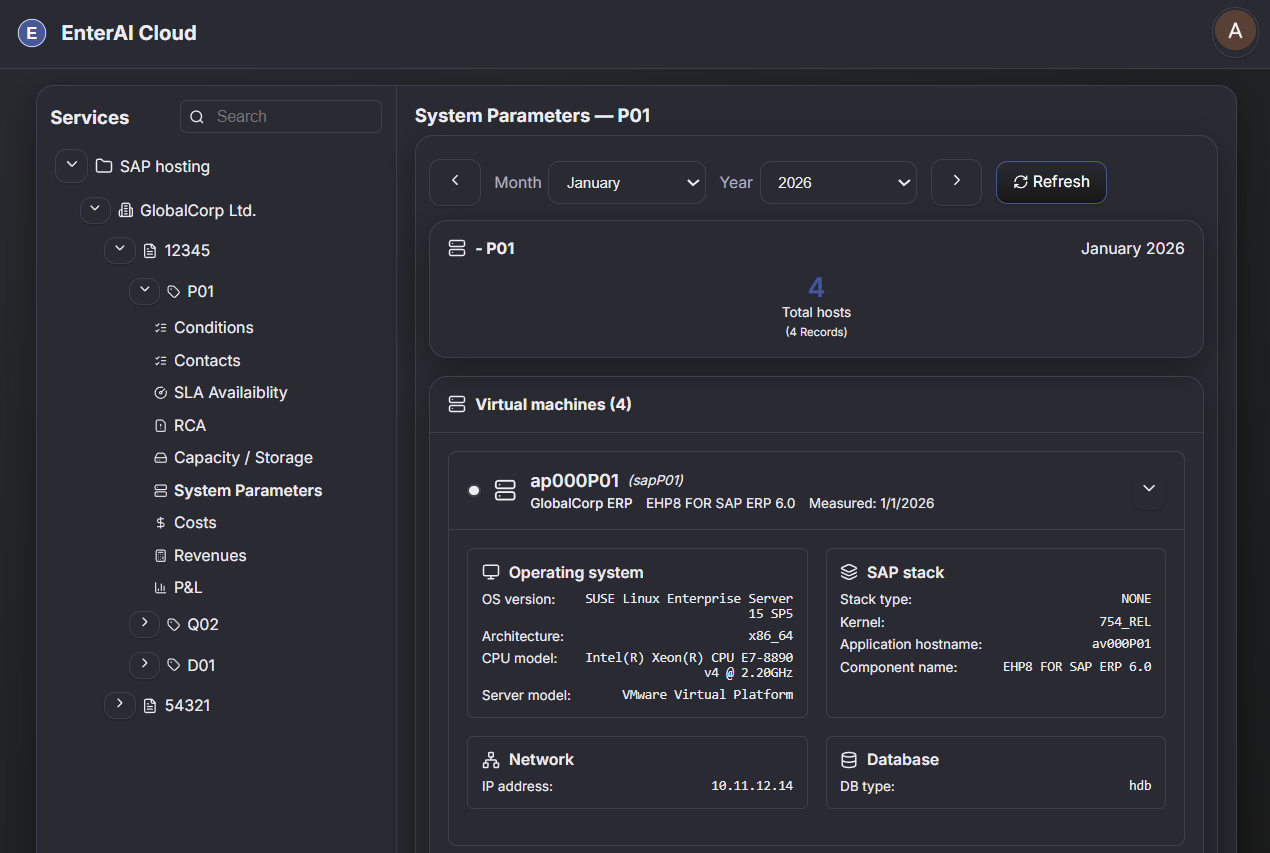
ADRAGON AI analyzes these reports and automatically maps the data to the correct contract items and configuration items in your CMDB. The result is a living CMDB that reflects reality — not assumptions or outdated documentation:
Storage overview
Capacity, usage, and growth
Filesystem setup
Mounts, layouts, and dependencies
Operating system
System parameters and versions
Applications
Runtime and configuration parameters
Network
Connectivity, ports, and segmentation
Databases
Instances, sizing, and configuration
Modern enterprises work with dozens—sometimes hundreds—of vendors. As a result, the contact matrix behind CMDB items quickly becomes complex, fragmented, and outdated.
ADRAGON AI continuously maps and reconciles contacts from dynamic sources and operational data and keeps the CMDB contact matrix clear, accurate, and always up to date for every configuration item.
Primary contacts
Who to call first
Escalation paths
Second and third levels
Vendors
Service providers per CI
Clients
Business owners and users
Support roles
Operational responsibilities
Tools
SNOW, Jira... queues
Assign costs to contract items already defined in your CMDB — and get a true cost view of IT.
ADRAGON AI matches monthly cost reports to the contract items and configuration items you already have in the CMDB. Finance and IT instantly see what you invest in, where the money goes, and where cost policy can be improved.
Cost breakdowns typically include databases, applications, virtual machines, storage, network elements, and more.
Databases
Licenses, hosting, ops
Applications
Runtime, support, usage
Virtual machines
vCPU, RAM, OS costs
Storage
Capacity, tiers, growth
Network
Links, firewalls, LB
Cloud services
Consumption + tags
Vendors
Invoices vs delivery
Anomalies
Deviations vs baseline
Turn your CMDB into a pricing engine. ADRAGON calculates monthly revenue per contract item and configuration item based on the parameters you already track — CPU, memory, storage, backup, and more.
Pricing stays explainable: every euro is tied to a measurable driver and can include SLA multipliers, tier breakdowns, and per-host allocation. This makes your internal chargeback, customer billing, and contract profitability reporting consistent — month after month.
Because the model is CMDB-based, it works for any contract scope — SAP, databases, apps, cloud services, infrastructure bundles, or fully managed environments.
Total price
Monthly revenue per service
SLA multiplier
Tier-based pricing uplift
CPU
vCPU × unit price
Memory
GB × unit price
Storage
GB × unit price
Backup
GB × unit price
Period
Month / year tracking
Per host
Allocation by hostname
If you are a vendor, ADRAGON turns your CMDB into a Profit & Loss engine. You instantly see Revenue, Costs, Gross Profit, and Margin for every contract item and every configuration item — exactly as defined in your contracts.
No more rebuilding profitability reports in spreadsheets. ADRAGON keeps a living P&L view that stays explainable and auditable: every euro is backed by CMDB evidence (tier, units, unit rates, SLA multipliers, host allocation, and period).
The result: clear answers in seconds — What is profitable? Where do we lose margin? Which customers, systems, or tiers drive the outcome?
Revenue
Per host, service, tier
Costs
Mapped to CMDB items
Gross Profit
Always reconciled
Margin
Profitability in %
Efficiency Ratio
Revenue-to-cost ratio
Monthly Trend
Revenue vs costs over time
Line-item Drilldown
Units × unit price
Audit Trail
Explainable, defensible P&L
ADRAGON makes it effortless to bring your Root Cause Analysis data into the CMDB and connect it to your RCA reports. The outcome is a clean, visual availability dashboard where every contract item has its own uptime calendar — and every day below 100% is fully explained.
No more hunting through emails, ticket queues, or scattered PDF reports. When availability drops (e.g., 99.90%), ADRAGON instantly shows the full story: impacted contract item, duration, current status, and the RCA narrative — ready for audit, SLA review, and customer communication.
This is how availability management becomes proactive: you see patterns, recurring causes, and risk hotspots across months — and you can fix what drives downtime, not just the symptom.
Availability Calendar
Uptime per contract item
Below-100% Drilldown
Every dip explained
RCA Pop-up Detail
Timeline + narrative
Outage Duration
Minutes, hours, impact
Status Tracking
Open, mitigated, closed
SLA Evidence
Audit-ready availability proof
Recurring Cause Insights
Patterns over months
Vendor Transparency
Explain issues in one view
Where living CMDB data becomes real-time interaction, automation, and user experience.
Users don’t need to know whether something is an incident or a change request. They just describe what they need — in plain language.
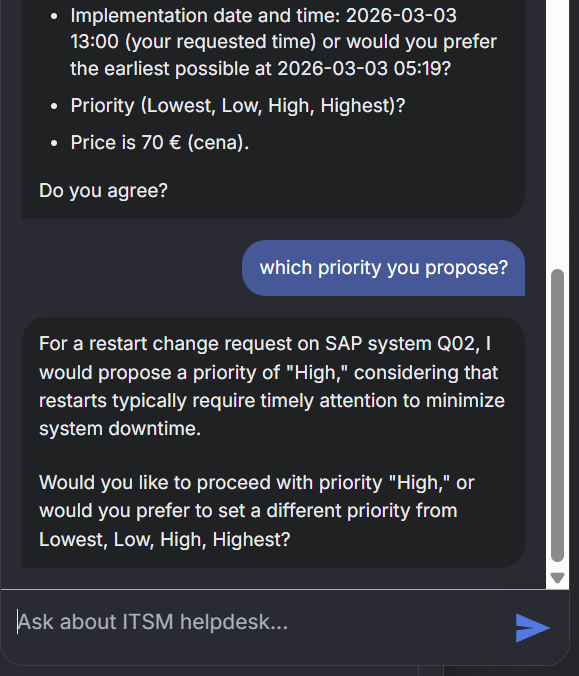
ADRAGON AI classifies intent, asks only what is necessary to remove ambiguity, captures mandatory details, proposes a priority, and then creates the request in the correct tool — consistently, every time.
The outcome: no wrong queues, no rework, no “missing fields” ping-pong — just clean tickets that can be executed immediately.
Intent detection
Incident vs change vs task
Guided questions
Only what’s needed
Mandatory fields
Always captured
Priority proposal
Confirm before submit
Tool routing
Correct system every time
Deterministic confirmation
Automation-ready output
No hallucinations
Ask until certain
Auditability
What was asked, why, when
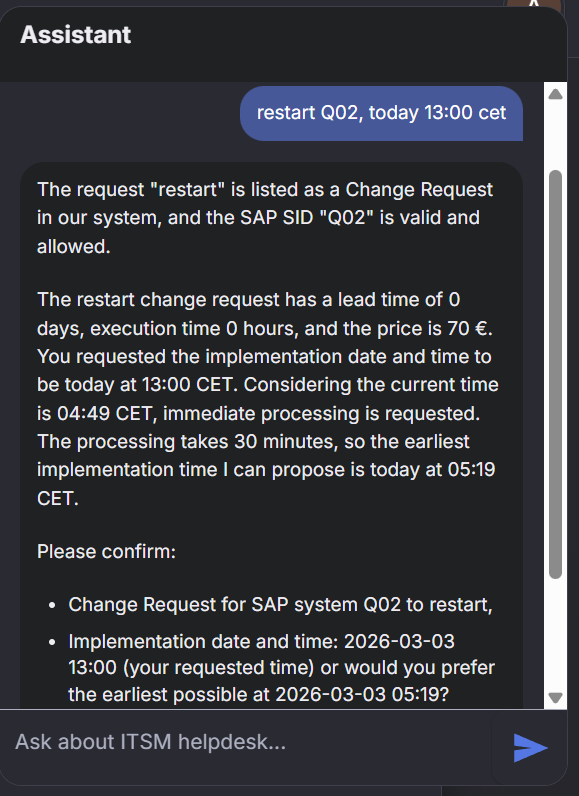
In many organizations, change requests silently become “free work” because pricing, lead times, and approvals are handled outside the ticket.
ADRAGON AI turns change requests into a controlled commercial flow: it validates the request against your catalog, proposes lead time and price, and asks for explicit user confirmation before submission.
When a request is not in the catalog, ADRAGON routes it to a manual approval path — still structured, still tracked, and still auditable.
Catalog validation
What is predefined
Lead time
Enforced before submit
Cena confirmation
No surprises later
Scheduling
Implementation window
Approval fallback
Manual when needed
Priority
SLA-aware proposal
Clean descriptions
Consistent formatting
Audit trail
Who confirmed what
Enterprises rarely run a single system. Incidents live in one tool, changes in another, and teams lose time switching context, chasing statuses, and reconciling truth.
ADRAGON keeps change requests and incidents synchronized, normalizes statuses into a shared vocabulary, and extracts reliable closure timestamps — so reporting and analytics stay accurate.
The result is a single operational picture without forcing a tool migration.
Status normalization
Same language everywhere
Closed time extraction
Reliable reporting
Real-time refresh
Always current
Cross-tool mapping
No manual reconciliation
Cost rollups
Change cost visibility
Overdue tracking
End dates and delays
Unified search
Number, customer, text
Requestor context
Who asked, when
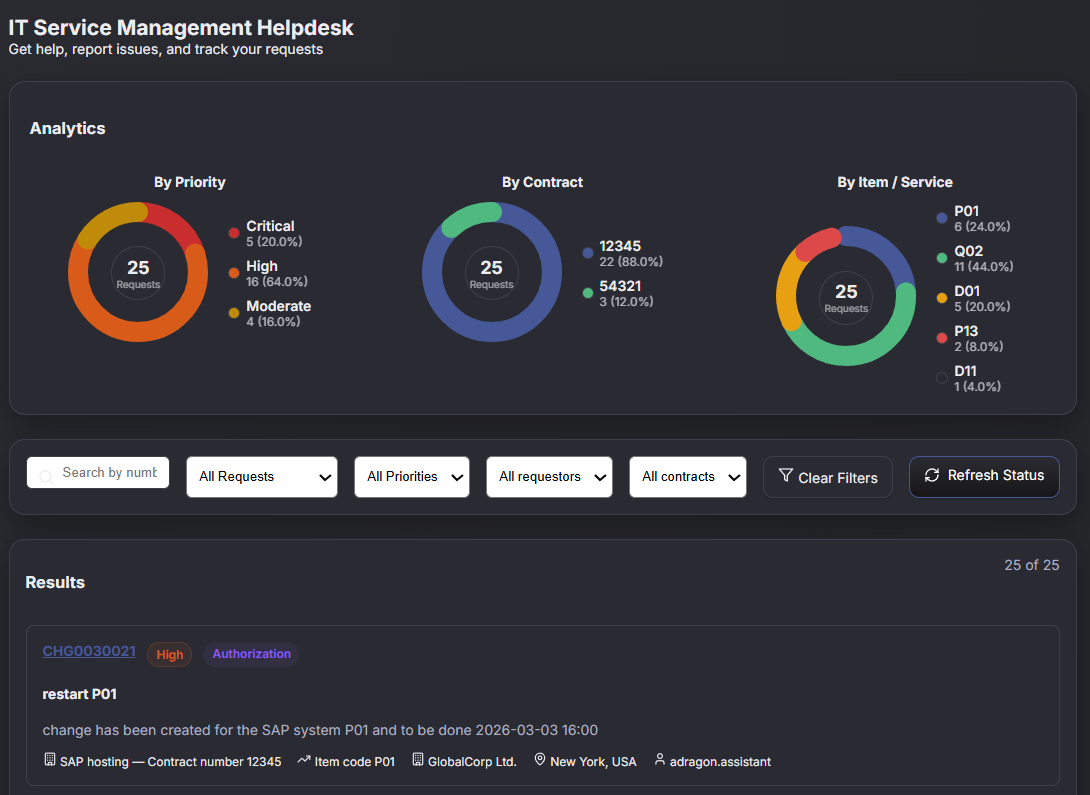
Most ITSM analytics are unreliable because tickets aren’t structured consistently. People skip fields, reclassify later, and the dataset becomes noisy.
ADRAGON fixes the root cause: ticket quality at creation time. When every request is captured cleanly, analytics become accurate by default — not by manual cleanup.
That means real-time visibility into priority load, customer hotspots, contract volume, and completion trends — without exporting to spreadsheets.
By priority
Live workload mix
By contract
Customer hotspots
By service / item
Where demand clusters
High priority
Immediate focus
Completion rate
Closed vs open
Requestor filters
Mine vs all
Search
Fast discovery
Refresh
Always current
Chat-based helpdesks fail in enterprises when access control is weak. ADRAGON is built for real-world governance: role-based access, policy-managed tables, admin-controlled UI visibility, and auditable changes.
Administrators can manage what roles can see or do — not only in the UI, but down to database-level policies (SELECT / INSERT / UPDATE / DELETE), keeping sensitive data protected.
This makes ADRAGON safe to deploy in regulated environments without sacrificing usability.
RLS policies
DB-level controls
Blueprint admin
Scoped administration
Widget visibility
Role-based UI
Audit logging
Traceable admin actions
Secure auth
JWT-based access
Least privilege
Reduce risk
Separation of duties
Ops vs admin
Compliance-ready
Enterprise safe
The biggest jump in value happens when a ticket becomes a workflow. ADRAGON produces deterministic, structured confirmation messages — making downstream automation safe and predictable.
That output can trigger orchestration in tools like n8n: approvals, scheduled changes, notifications, and implementation workflows — without fragile parsing or manual copy/paste.
ADRAGON turns ITSM from “documenting work” into “executing work.”
Deterministic output
Automation-safe messages
Workflow triggers
n8n, scripts, runbooks
Approvals
Controlled execution
Scheduling
Date/time-ready
Notifications
Users + teams
Policy enforcement
Before execution
Reduced MTTR
Less waiting, less rework
Explainability
Why the workflow ran
Most organizations learn about SLA risk too late: when the deadline is already missed, escalations begin, and penalty conversations start.
ADRAGON continuously evaluates request status, priority, due dates, and historical flow patterns to detect early signals of SLA breach risk — and makes that risk visible while there is still time to act.
The result: proactive operations, smarter escalations, and fewer penalty events — without relying on manual monitoring.
Risk scoring
Early warning signals
Due date monitoring
Overdue prevention
Priority-aware
Higher risk for critical
Stale ticket detection
No movement alerts
Escalation guidance
Who to notify
Customer transparency
Risk visible early
Trend patterns
Recurring bottlenecks
Penalty reduction
Prevent breach events